earthkit.meteo.wind.direction
- earthkit.meteo.wind.direction(u: ArrayLike, v: ArrayLike, convention: str = 'meteo', to_positive: bool = True) ArrayLike
- earthkit.meteo.wind.direction(u: xarray.DataArray, v: xarray.DataArray, convention: str = 'meteo', to_positive: bool = True) xarray.DataArray
- earthkit.meteo.wind.direction(u: earthkit.data.FieldList, v: earthkit.data.FieldList, convention: str = 'meteo', to_positive: bool = True) earthkit.data.FieldList
- earthkit.meteo.wind.direction(u: earthkit.data.Field, v: earthkit.data.Field, convention: str = 'meteo', to_positive: bool = True) earthkit.data.Field
Compute the direction/angle of a vector quantity.
- Parameters:
u (
array-like | xarray.DataArray | FieldList | Field) – u wind/x vector componentv (
array-like | xarray.DataArray | FieldList | Field) – v wind/y vector component (same units asu)convention (
str, optional) –Specify how the direction/angle is interpreted. The possible values are as follows:
”meteo”: the direction is the meteorological wind direction (see below for explanation)
”polar”: the direction is measured anti-clockwise from the x axis (East/right) to the vector
to_positive (
bool, optional) – If True, the resulting values are mapped into the [0, 360] range whenconventionis “polar”. Otherwise they lie in the [-180, 180] range.
- Returns:
Direction/angle (degrees)
- Return type:
array-like | xarray.DataArray | FieldList | Field
Notes
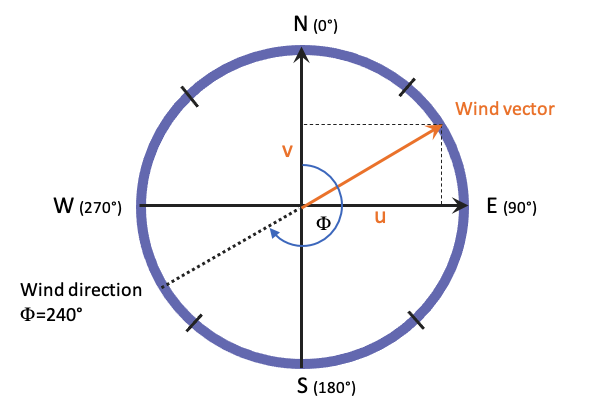
The meteorological wind direction is the direction from which the wind is blowing. Wind direction increases clockwise such that a northerly wind is 0°, an easterly wind is 90°, a southerly wind is 180°, and a westerly wind is 270°. The figure below illustrates how it is related to the actual orientation of the wind vector:
Implementations
direction()calls one of the following implementations depending on the type of the input arguments:earthkit.meteo.wind.array.direction()for array-likeearthkit.meteo.wind.xarray.direction()for xarray.DataArrayearthkit.meteo.wind.fieldlist.direction()for FieldList | Field
The function returns an object of the same type as the input arguments.